Ductless Heat Pumps.
Heating & Cooling Without the Ductwork.
A ductless heat pump is one outdoor unit connected to one or more indoor air handlers by a thin copper lineset — no ducts, no soffits, no big furnace closet. The same hardware cools your home in summer and heats it in winter, and it does both with less electricity than almost anything else on the market. Most people just call them mini splits. This guide is the version we wish was online when we were shopping for one ourselves.

What most people want to know first
We get the same handful of questions every week. Quick answers below — the rest of the page covers each in more detail.
Does it actually work in winter?
Yes — modern ductless heat pumps keep heating down to about -13°F outside. They pull heat from the cold air the same way a fridge pulls heat from food. People in interior British Columbia and the Northeast run them as primary heat all winter.
What does it actually cost?
Installed cost is typically $3,000–$10,000+ through a contractor, depending on zone count and complexity. A DIY install with a pre-charged Zone Air system runs $1,900–$5,200 and skips the labor entirely.
Will it lower my energy bill?
Switching from electric resistance or an oil boiler usually cuts heating bills by 25–40%. A heat pump moves heat instead of burning fuel or running a resistance coil, so you get roughly 3 units of warmth for every 1 unit of electricity. No ductwork means no ducts wasting energy.
Can it heat my whole house?
Yes — with a multi-zone setup. One outdoor unit feeds several indoor units (typically 2–5), each on its own thermostat. Whole-house ductless layouts are common in retrofit homes that never had ducts in the first place.
How long does installation take?
A single-zone install is usually about five hours — sometimes faster, sometimes longer if drilling through brick. The install itself only needs one 3-inch hole in an exterior wall for the lineset to pass through.
Are they DIY-able?
Pre-charged systems, yes. The pre-charged lineset ships filled with refrigerant and quick-connects to both units, so you never open the refrigerant circuit — no vacuum pump, no EPA license. DIY savings typically run $3,000–$5,000 per zone vs. paying a contractor.
How a heat pump heats and cools without ducts
A ductless heat pump is the same refrigeration cycle your fridge uses, scaled up to a house and made reversible. Ductless heat pumps operate by using electricity to move refrigerant between the indoor and outdoor units, picking up heat in one place and releasing it in another. In summer, the cycle pulls heat out of your living room and dumps it outside — that's air conditioning. In winter, a valve flips the direction of the cycle so it captures heat from the outdoor air, even when it's freezing, and brings it inside. Same hardware, two seasons.
What makes it efficient is the inverter compressor in the outdoor unit. Instead of switching on at full blast and off again every few minutes (the way older central HVAC works), the inverter ramps smoothly between 25% and 100% capacity. On a mild day it loafs along; on a peak day it pushes hard. That smooth modulation, plus zero ducts to leak heat, is why ductless mini split heat pumps can hit SEER2 of 22 or higher — significantly more efficient than traditional central air conditioning systems, which can lose 25–40% of cooling energy through ductwork before it ever reaches a room.
The main components of a mini split
A ductless mini split has only a few real parts, and it helps to know what each one does before you talk to an installer or unbox a DIY kit.
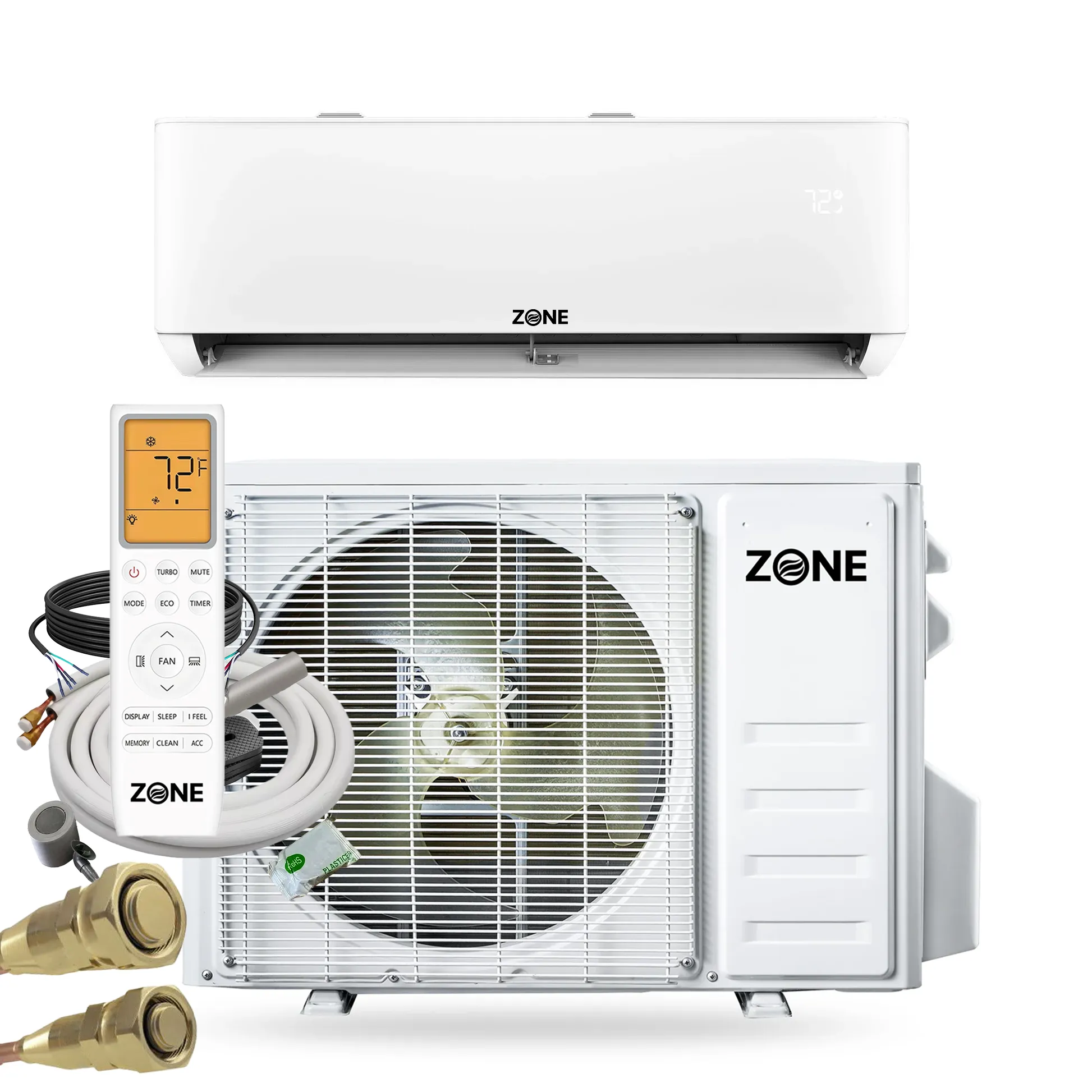
- The outdoor unit — the box that sits on a small pad outside, or on a wall bracket. It contains the inverter compressor, the outdoor coil, and a fan. This is the part that actually does the work of moving heat.
- The indoor air handler — the slim white box mounted on the wall (or hidden in a ceiling cassette). It has a coil, a quiet blower fan, and a filter. Conditioned air comes out of here.
- The refrigerant lineset — two insulated copper lines that connect the outdoor and indoor units. With pre-charged systems, this lineset arrives sealed and pre-filled.
- The control wiring — a four-wire cable so the indoor and outdoor units can talk. The remote control on the wall (or in your hand) tells the indoor unit what temperature you want; the indoor unit tells the outdoor unit how hard to work.
Ductless mini split vs central HVAC and other systems
The right system depends mostly on what you already have. If your home was built around ductwork and the ducts are in decent shape, central HVAC and a ductless heat pump can both work. If you've never had ducts — or your ducts run through a hot attic and leak conditioned air everywhere — ductless almost always wins once you do the math.
| System | Cooling efficiency | Heating efficiency | Installed cost (typical) | Best fit |
|---|---|---|---|---|
| Ductless mini split heat pump | 22–25 SEER2 | 9.0–11.0 HSPF2 | $2,000–$10,000 | Homes without ducts, room additions, room-by-room control |
| Central heat pump (ducted) | 15.2–18 SEER2 | 7.8–9.0 HSPF2 | $8,000–$16,000 | Whole-house replacement where good ducts already exist |
| Central AC + gas furnace | 14–17 SEER2 | 80–95% AFUE (gas) | $10,000–$18,000 | Cold-climate homes already plumbed for natural gas |
| Window AC + electric baseboard | 10–12 CEER | 100% (resistance) | $500–$3,000 | Renters, very small spaces, or backup only |
| Portable AC + space heater | 8–10 CEER | 100% (resistance) | $300–$1,200 | Temporary use — the least efficient option on this list |
The honest takeaway: against a central HVAC system in a home that already has clean ducts, the cost comparison is closer than people think. Central wins on per-square-foot install cost; ductless wins on efficiency and on not having to retrofit anything. Against window units or baseboard heat, ductless mini splits cut energy use 50–70% and pay back in four to eight years depending on local electricity rates.
Ductless heating in cold climates
The old myth that heat pumps don't work below freezing comes from R-22 equipment that's now 20+ years out of date. Modern cold-climate systems are a different animal — many ductless heat pumps are designed to operate efficiently in freezing conditions, holding close to 100% of their rated heating capacity down to roughly 5°F outside, and continuing to deliver useful heat down to -13°F or lower.
Zone Air units are continuous-rated to -13°F. Below that, output drops but the unit keeps running. For the very coldest U.S. climate zones (northern Minnesota, Maine, North Dakota, the higher-elevation parts of the Rockies, interior British Columbia), the standard approach is to size the heat pump to handle the load comfortably down to about 5°F and pair it with a backup heat source — electric resistance strips, an existing furnace running in dual-fuel mode, or a wood stove — for the handful of hours each year that outside temperatures fall below the heat pump's comfortable operating range. In that arrangement, the heat pump still handles the vast majority of annual heating hours and the backup barely runs.
Sizing a ductless mini split system
Roughly 20 BTU per square foot is the starting point. From there, adjust for the things that change a room's load:
- 9,000 BTU covers 200–350 sq ft — bedrooms, home offices, small studio apartments. Browse 9,000 BTU systems →
- 12,000 BTU covers 350–550 sq ft — master bedrooms, living rooms, finished basements. By far the most-installed size. Browse 12,000 BTU systems →
- 18,000 BTU covers 600–850 sq ft — great rooms, large basements, accessory dwelling units. Browse 18,000 BTU systems →
- 24,000–30,000 BTU is usually a multi-zone — two indoor heads sharing a single, larger outdoor unit. Browse dual-zone bundles →
Then derate or scale up: drop ~15% for shaded north-facing rooms, scale up if the ceilings are higher than eight feet, add about 4,000 BTU for a kitchen, knock off some for a well-insulated basement. Sizing a ductless heat pump system correctly is crucial; an improperly sized system can lead to short cycling, which makes the room less comfortable and costs more to run. Oversizing is the more common mistake — a 12K running at 35% all day is less efficient and less comfortable than a 9K running at 80%. For multi-room projects, do a Manual J load calculation instead of guessing per room. The sizing guide walks through it.
Single zone vs multi-zone ductless systems
Ductless mini-split systems can be categorized into single-zone and multi-zone. Single-zone systems consist of one indoor and one outdoor unit — the right call for a single room, a converted garage, an ADU, or any open-plan space you condition as one zone. Multi-zone systems can support multiple indoor units connected to a single outdoor unit, with as many units as 2–5 indoor heads sharing one outdoor condenser, each with its own thermostat and its own remote control.
Multi-zone wins when you want independent temperature control across specific rooms with only one outdoor unit (one wall penetration, less yard footprint). Two separate single-zone systems can occasionally beat a single multi-zone — usually when the rooms are far apart (more than 50 ft of lineset between them) or when you want failure isolation so one compressor failure doesn't take out the whole house. For a typical two-room project, a dual-zone bundle is usually the cleanest answer.
Mini-split heat pumps are versatile and can be used in various applications — residential, commercial, and institutional buildings, plus retrofits for homes without ductwork. The same hardware that conditions a primary bedroom can condition a small office, a workshop, or a server room.
Wall mounted, floor mounted, and ceiling cassette air handlers
Ductless systems can be installed in different configurations, such as wall-mounted, floor-mounted, and ceiling cassette, so the same outdoor unit can pair with whatever indoor unit suits the room. Wall mounted is the default — fastest to install, widest BTU range, and lowest cost. Ceiling cassette recesses into a drop ceiling with four-way airflow and is the right pick when you don't want anything visible on the wall. Concealed-duct units tuck above a soffit or in the attic and feed a small register grille, which gives you a central-air look without the central-air install.
Wall Mounted
Mounts six to eight feet up on an exterior wall, blows air down and out. Easiest install, widest BTU range. From $1,899.
Shop wall mounted →Ceiling Cassette
Recessed into a drop ceiling with four-way airflow. Best for square rooms where you want even distribution and no wall presence. From $2,399.
Shop ceiling cassettes →Concealed Duct
Hidden above a soffit or in the attic, ducted to a register or two. Looks like central air without the central-air install. From $2,499.
Shop concealed duct →Are ductless heat pumps really energy efficient?
Short answer: yes, by quite a lot. Two things drive it. First, no ductwork. A traditional ducted system sends cooled or heated air down a long, leaky path through unconditioned attics and crawlspaces — duct losses commonly eat 25–40% of what the unit produces. A ductless mini split delivers conditioned air directly into the room from an air handler on the wall, so almost none of that energy gets wasted.
Second, the inverter. A heat pump compressor that can throttle smoothly between low and high spends most of its time loafing along at a fraction of full power. That's why the same family of equipment that hits SEER2 of 22 or higher in cooling also hits HSPF2 of 9–11 in heating. Many modern ductless mini-split systems are ENERGY STAR certified, meeting strict efficiency thresholds set by the EPA and qualifying for federal and state incentives — many ENERGY STAR certified air-source heat pumps are eligible for a federal tax credit of up to $2,000, and most state and utility programs stack rebates on top of that.
Switching to a heat pump from electric resistance or oil heating typically lowers energy bills by 25–40%. If you're already on natural gas, the savings are smaller and the math depends on local gas and electricity prices — but you still gain efficient cooling in summer that you didn't have before.
Air conditioning, dehumidification, and indoor air quality
In cooling mode, a ductless heat pump works exactly like a high-end split-system air conditioner — it captures heat from inside the home and releases it outdoors in summer. Because the inverter modulates instead of cycling on and off, it pulls humidity out of the air more steadily than a window unit can, which is why ductless air conditioning generally feels more comfortable at the same thermostat setting. And because ductless systems are exceptionally quiet compared to traditional central air, they're a much better choice for bedrooms and home offices — most indoor mini splits run quieter than a fridge on the low fan setting.
Every indoor unit ships with a washable filter that catches dust and pet hair. The air quality benefit is modest — it's a HEPA-adjacent particulate filter, not a medical-grade air purifier — but for everyday indoor air quality it's a clear step up from a window air conditioner with no filter, or from a forced-air system running through dusty ducts. Pull the filter out once a month during heavy use, rinse it in the sink, let it dry, and slide it back in.
Cost, rebates, and where the money actually goes
Equipment-only pricing for a single-zone ductless heat pump from a name-brand manufacturer typically runs $1,500–$3,500 at 9K–18K BTU. Zone Air systems with a pre-charged DIY lineset price in at $1,899–$2,599 — about the same as traditional flare-fit equipment, because the cost of the pre-charged lineset offsets the vacuum-pump labor you no longer pay for.
Where the money really moves is on labor. Pro install runs $1,500–$3,000 per zone on top of equipment. DIY install with a pre-charged system is essentially free — $0 if the model is 115V plug-and-play, $300–$600 if you need an electrician to add a 230V circuit. Total installed cost on the low end is around $1,900 (DIY single-zone 115V); on the high end it's $10,000+ for a pro-installed dual-zone with electrical work.
On the rebate side, the federal Energy Efficient Home Improvement Credit (25C) covers 30% of the cost of a qualifying ductless heat pump up to $2,000 per year. Zone Air systems meet the CEE Tier thresholds (≥16 SEER2 / ≥9 HSPF2 / ≥10 EER2 for split systems in the North) needed to qualify. State and utility programs stack on top of the federal credit — eligible systems for ductless heat pumps can benefit from local tax rebates and utility incentives, with Northeastern utilities (National Grid, Eversource, NYSERDA, Mass Save) offering $1,000–$2,500 per ton. The IRA HEEHRA program covers up to $8,000 per household for income-qualified installations. The rebates database has the current numbers by state.
Pro install vs DIY ductless mini install
Traditional ductless mini split installs need a licensed HVAC technician with EPA Section 608 certification — they evacuate the lineset with a vacuum pump, pressure-test with nitrogen, and charge the system with refrigerant. The certification requirement exists because the technician is opening the refrigerant circuit. That step is what drives professional labor to $1,500–$3,000 per zone.
A DIY ductless heat pump with a pre-charged refrigerant lineset never opens the refrigerant circuit. The system ships with refrigerant already loaded; the quick-connect couplings hand-tighten and torque to spec, and the system is ready. No license, no vacuum pump, no charging, no certification fee. A first-time DIY installer can complete a single-zone wall mount in about five hours — sometimes faster if the wall is wood frame, longer if you're drilling through brick. 115V models plug into a standard 15A outlet, which removes the electrician requirement entirely.
Before installation day — whether you're doing it yourself or having a contractor do it — move furniture away from the wall where the indoor unit will mount and clear a path through the rooms the installer needs to reach. Locate the breaker panel and confirm a free circuit. If you're going pro, ask whether the line hide cover, condensate pump, and outdoor disconnect box are included in the quote. With some other companies they're separate line items.
The drawbacks no one mentions on glossy brochures
Three honest downsides worth knowing about up front:
- The indoor unit is visible. The biggest complaint about ductless heat pumps is that the air handler hangs on the wall in plain sight. Some homeowners hate the look. Ceiling cassettes and concealed-duct units fix this but cost more.
- Multi-zone gets expensive fast. One outdoor unit plus four indoor units sounds simple, but each additional indoor head adds equipment and labor. A four-zone install can cost more than central HVAC in a home that already has ducts.
- Refrigerant leaks happen. Any refrigerant system can develop refrigerant leaks at the fittings over time, especially if the original install was rushed. Pre-charged systems with quick-connect couplings cut the leak rate substantially because they're factory-torqued and don't rely on a field-flare seal.
None of these are dealbreakers for most homes, but they're fair to know before you commit.
Best Mini Split Heat Pumps for 2026
Three Zone Air systems cover the most common scenarios. All three ship with a pre-charged lineset for DIY install, free shipping nationwide, and a 7-year compressor warranty.
9,000 BTU 115V Wall Mount
Plug-and-play single-zone ductless heat pump. 200–350 sq ft. Heats to -13°F. No electrician needed.
View product →Most Popular12,000 BTU 115V Wall Mount
The most-installed size. 350–550 sq ft. Living rooms, master bedrooms, finished basements.
View product →2-Room SolutionDual Zone 24,000 BTU Bundle
Two indoor heads, one outdoor unit. Independent thermostats per room. Pre-charged for DIY.
View product →Ductless heating and cooling FAQ
The questions people actually ask before they buy — sizing, cost, cold-weather performance, DIY install, and rebates.
Do ductless heat pumps actually work in freezing weather?
How much does a ductless mini split system cost installed?
Will I really save money on energy bills?
How long do ductless heat pumps last?
Single zone or multi-zone — what do I actually need?
What size do I need for my room?
Can I install a ductless mini split myself?
Do I need to prepare anything before installation day?
What rebates and tax credits can I claim?
What's the difference between a ductless heat pump and a mini split?
Related Guides
Ready to choose a ductless heat pump?
Browse the full Zone Air catalog — single-zone, multi-zone, and every form factor. Pre-charged for DIY install, free shipping, 7-year compressor warranty.
Shop All Ductless Heat Pumps